There is nothing quite as satisfying as sliding a piping hot cast-iron teapot or simmering Dutch oven onto a thick, handmade surface that guards your tabletop with rustic grace. The Easy Farmhouse Crochet Trivet Hot Pad is thoughtfully designed with dense circular cotton rounds and clean spiral ridge definition that effortlessly absorbs extreme thermal heat. Worked with two strands of worsted cotton held together or heavy-weight kitchen cotton, this quick afternoon project brings timeless cottage warmth and practical tabletop protection to any home kitchen.
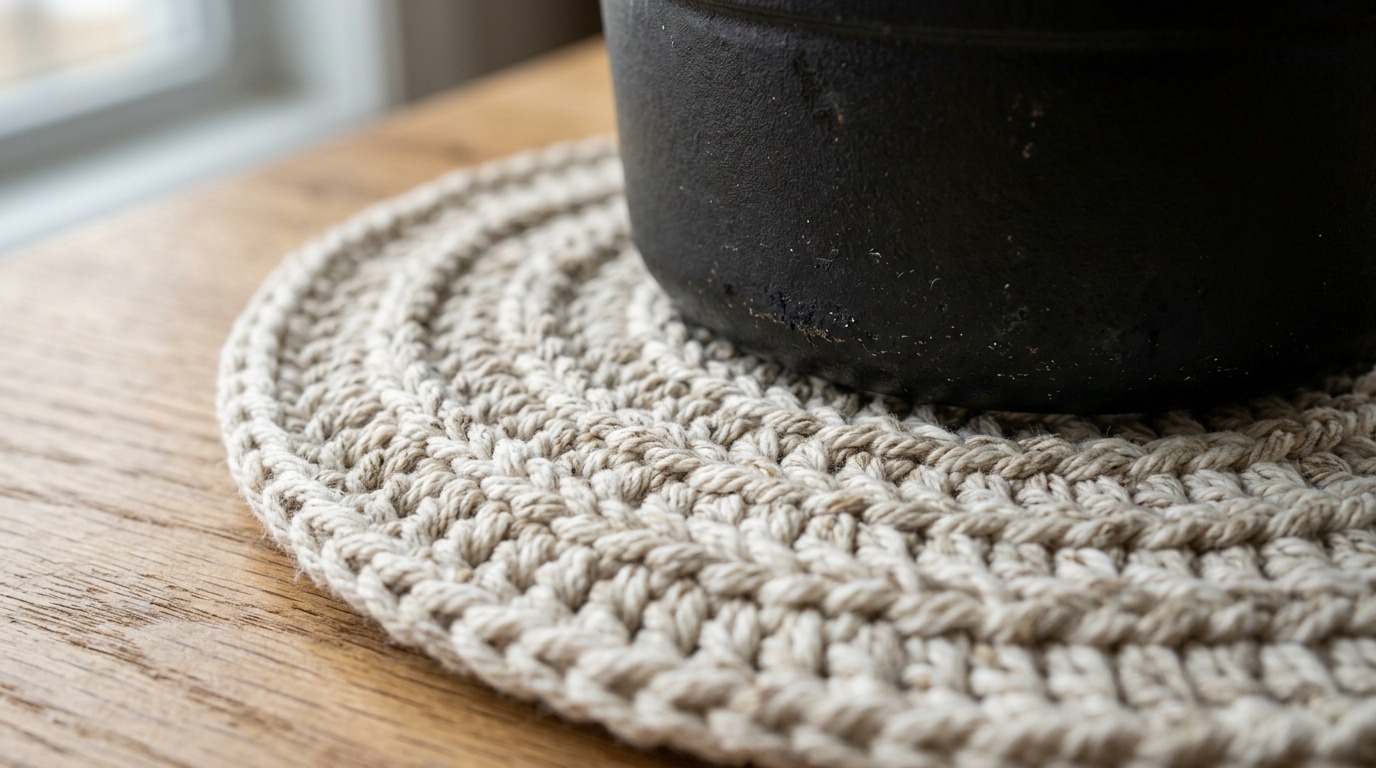
Unlike delicate decorative doilies that buckle under warmth, a functional kitchen trivet requires structural density, flat perimeter tension, and natural fiber durability. By crocheting with a compact gauge and incorporating an integrated hanging loop, this trivet transitions seamlessly from an active tabletop workhorse to charming wall-hung kitchen decor when the meal is over.
Why You’ll Love This Pattern
- Extreme Heat Protection: 100% natural cotton fibers will never melt or scorch under boiling kettles, Dutch ovens, or hot baking dishes.
- Super Speedy Project: With bulky yarn or worsted strands held double, you can easily finish a completed trivet in under 45 minutes.
- Lies Completely Flat: Precision stitch increments in each concentric round guarantee a perfectly flat surface with zero curling or rippling.
- Charming Cottage Aesthetic: Natural cream cotton and clean textured rounds blend beautifully into modern farmhouse, Scandinavian, or rustic kitchens.
Key Materials & Smart Swaps

- 100% Worsted Cotton Yarn: Approximately 85 yards of durable cotton (such as Lily Sugar’n Cream, Dishie, or Lion Brand 24/7 Cotton). Crucial rule: Never use acrylic or polyester, which will instantly melt under high cooking temperatures!
- Crochet Hook: Size J-10 (6.0 mm) smooth wooden or ergonomic aluminum hook. Using a slightly compact hook creates the dense, firm fabric needed for tabletop protection.
- Tapestry Needle: Large-eye blunt needle for weaving in sturdy cotton yarn tails.
- Locking Stitch Marker: Essential for marking the beginning of continuous spiral rounds without creating an unsightly seam.
- Sharp Snip Scissors: For crisp, clean yarn trimming.
Step-by-Step Crochet Walkthrough
1. Foundation & Magic Ring: Create a magic adjustable loop (or chain 4 and slip stitch into the first chain to form a small ring). Chain 1 (does not count as a stitch), and work 8 half double crochet (hdc) stitches directly into the center ring. Pull the tail gently to close the center hole firmly.
2. Round 2 (Doubling Increases): Do not join with a slip stitch; work in continuous spiral rounds for a flawless surface. Place your locking stitch marker in the first stitch. Work 2 hdc into each stitch around (16 hdc total). Move your stitch marker up to the first stitch of each successive round.

3. Rounds 3 through 7 (Gradual Expansion): Continue increasing symmetrically across each round: • Round 3: *1 hdc in next st, 2 hdc in next st* repeat around (24 sts). • Round 4: *1 hdc in next 2 sts, 2 hdc in next st* repeat around (32 sts). • Round 5: *1 hdc in next 3 sts, 2 hdc in next st* repeat around (40 sts). • Round 6: *1 hdc in next 4 sts, 2 hdc in next st* repeat around (48 sts). • Round 7: *1 hdc in next 5 sts, 2 hdc in next st* repeat around (56 sts). Your disc should measure approximately 8.5 to 9 inches across.
4. Border & Sturdy Hanging Loop: Work 1 single crochet in each of the next 2 stitches, then 1 slip stitch in the following stitch to smooth down the spiral round. To make the hanging loop, chain 12, slip stitch back into the base of the same stitch, turn, and work 14 single crochet stitches around the chain-12 loop for reinforced strength. Fasten off and weave the end deeply into the dense backside stitches.
3 Pro Tips for Perfect Results
1. Maintain Firm, Even Stitch Tension: If your tension is too loose, the trivet will become pliable and permit heat transfer. Keep your loops snug against the hook shaft so the resulting pad is dense, supportive, and firm enough to balance cookware effortlessly.
2. Steam Block for a Glass-Flat Finish: Natural cotton yarn possesses tremendous memory. Once your trivet is complete, pin it into a true circle on a blocking mat and steam vigorously with an iron held 1 inch above the fabric (never press directly down). Let it cool completely to lock the flat circular geometry.
3. Stagger Your Increase Placements: If you notice subtle hexagonal edges forming around Round 6, offset your increases on even-numbered rounds (e.g., in Round 6, work 2 hdc in first st, then 4 hdc, rather than increasing at the end of each repeat). This maintains a silky circular contour.
How to Style & Use Your Crochet Trivet

- Morning Tea & Coffee Station: Place beneath an electric gooseneck kettle, ceramic teapot, or French press to absorb drips and protect wooden countertops.
- Holiday Dining Centerpiece: Group two or three trivets down the middle of a rustic dining table runner to cradle piping hot casserole dishes and Dutch ovens.
- Decorative Kitchen Wall Accent: Use the sturdy reinforced loop to hang your trivet from brass kitchen hooks or an open shelving pegboard for instant artisanal charm.
- Thoughtful Housewarming Gift: Tie a rolled cotton trivet with natural jute twine and pair with artisan sea salt or wooden cooking spoons for an unforgettable homemade gift.
Care, Washing & Blocking Guidelines
- Machine Washing: Place inside a mesh delicates laundry bag and wash in cold or warm water with mild detergent on gentle cycle.
- Drying Method: Reshape while damp and lay flat on a dry towel. Do not tumble dry on high heat, which may shrink cotton fibers unevenly.
- Stain Removal: For kitchen grease or sauce splatters, treat immediately with a dab of dish soap or baking soda paste prior to washing.
Frequently Asked Questions
Can I use acrylic or wool yarn for this crochet trivet?
No, never use acrylic yarn for trivets or hot pads, as synthetic fibers melt when in contact with hot pots and pans. Pure 100% cotton or unmercerized linen is strictly required for genuine heat resistance.
Why is my crochet circle curling into a bowl?
Curling happens when there are not enough increase stitches in each round or your tension is too tight. Ensure you count your stitches precisely and increase by 8 stitches per round. If tension is very tight, try going up half a hook size.
Can I hold two strands of cotton together for extra thickness?
Yes! Holding two strands of worsted cotton together with an 8.0 mm (L-11) crochet hook makes an ultra-plush, heavy-duty trivet that provides commercial-level counter protection.
Save This Pattern on Pinterest
Love this cozy kitchen project? Pin the master graphic below to your favorite crochet or home decor board on Pinterest so you have it ready for your next weekend crafting session!